
Does the Center Hold?
On returning to the same questions, and being recognised anyway

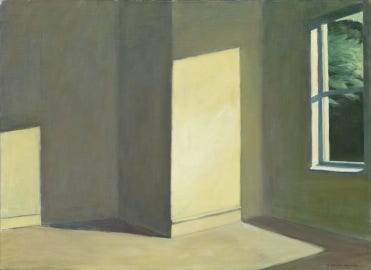
In the morning varying patterns of light flows into the floor with the quiet authority of something that does not need permission, and throughout the day it lengthens, fractures along the window frame, gathers itself on the wall, trembles when branches outside decide to participate, and by evening it has grown almost theatrical, touching objects it ignored at noon as though it has developed new affections.
If someone documented only these shapes, hour after hour, they might conclude that the light is unreliable, perhaps temperamental, forever revising its loyalties. But the light is not what is changing, what changes is the arrangement of what receives it. I return to this thought often, especially on days when I catch myself worrying that my own life, viewed from a distance, might look like a collection of revisions rather than continuity. Yesterday I argued for structure; today I speak about dissolution. One week I am obsessed with systems; the next I am painting figures that seem to be evaporating into landscape. In one conversation I am pragmatic, almost severe; in another I am porous, easily undone by a shadow moving across a cup. If a person were to map only these moments, the diagnosis might be inconsistency. Yet from inside the experience, it feels less like swinging and more like returning.
Because I keep coming back to the same questions, sometimes with irritation, sometimes with gratitude, but always with recognition. How do we belong to the world without disappearing inside it? What does it mean to build without losing soul? Why am I forever drawn to thresholds, to edges, to things that are neither fully formed nor fully gone? Why do birds keep entering my work? Why jars, why windows, why the drama of emergence and retreat?
I have tried, occasionally, to become someone with newer fascinations, someone less predictably moved by light, someone who does not pause mid-sentence because the afternoon has decided to rearrange the wall. But my hands betray me. If left unattended, they return to the same gestures.
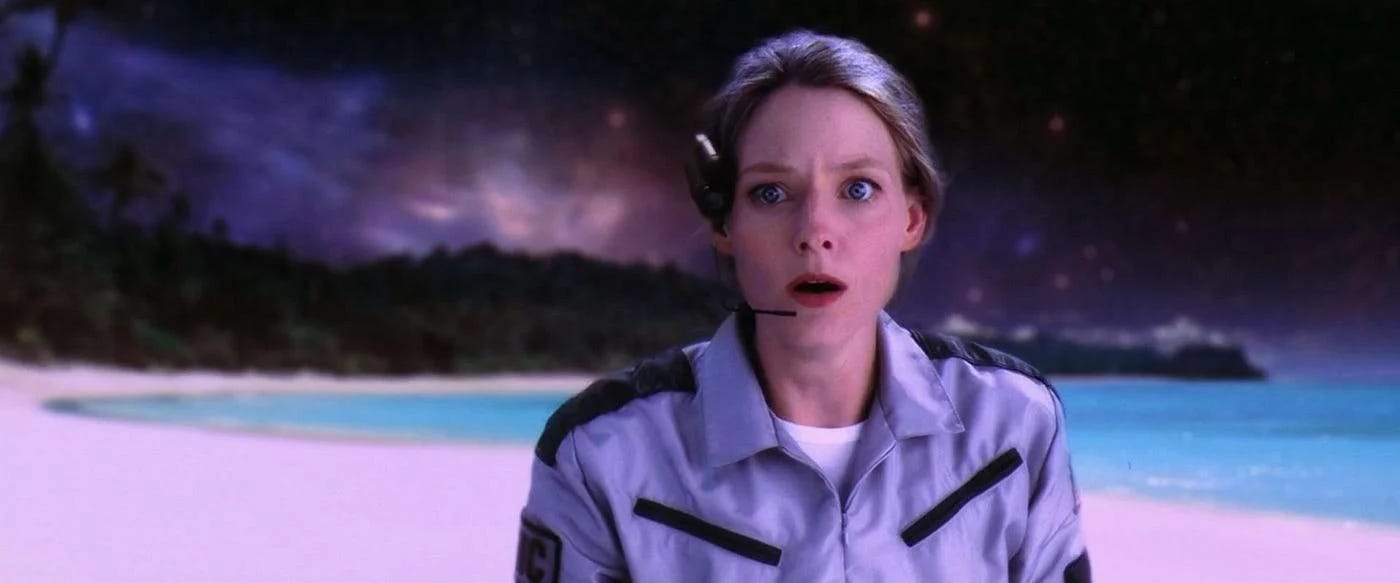
My husband laughs about this. He says there are parts of me that are permanently installed, like the way I cook certain meals as if repetition were a sacred duty, or the way I watch Contact each time with undiminished awe, as though the universe might finally alter the ending out of respect for my loyalty. I have seen it more times than I admit publicly, and yet the wonder arrives on schedule, punctual as faith. He says this with affection, but also with the mild astonishment of someone observing a phenomenon that refuses to update itself. I can write an essay on how much I enjoy watching the movie. The way she held on to her belief in the journey that others didn’t choose to recognise is something I think of often.
The other day I was trying, with great seriousness, to explain my professional anxieties to him, how perhaps the grand rooms are not the ones in which I will be properly seen, how scale can be blinding, how recognition might come more easily to those who are building something tender and necessary rather than monumental. I spoke about devotion, about wanting my work to matter where the human spirit is still warm enough to receive it. He listened, the way he does, quietly, without rearranging me. Then he said he had always imagined I might run a book café, or give my hours to people trying to build with care, or spend afternoons conducting creative workshops for children who have not yet learned to be embarrassed by their imagination.
Not because I lack ambition, he added quickly, seeing my face reorganise itself, but because I return, unfailingly, to aliveness in others. Because I am interested in ignition. Because I seem happiest where growth is intimate and visible.
It startled me, the way simple recognitions do. As if someone had pointed at the light instead of the shapes. At some point I stopped calling this lack of evolution. I begin to suspect this might be fidelity. A life looks erratic when looked with busyness. But when someone pays attention, the same life show its grammar. And there are certain devotions that refuse to leave, no matter how many costumes we may try on. The same tenderness reappears with new vocabulary. The same unease keeps asking to be understood from different angles. We travel far only to discover we have been orbiting.
It feels like light entering different rooms. The floor invents infinite geometries, and observers, loyal to surfaces, argue about the shapes. Meanwhile the source continues its old offering without commentary.
It reminds me of conversations with my dear friend Smruti Choudhury on friendships. We have often spent time talking about it often through different angles like the light entering into the room through different angles. We mostly have arrived at the same destination travelled from different angles. These days I have the leisure of looking back at my life with an awareness that does not demand resolution, only the compassion to see that the pieces had always been trying to fit. The understanding arrives late, faithful to the temperament of a true late bloomer.
We do not move in circles but in spirals, returning to familiar places with altered altitude. The sentence feels less like instruction and more like relief when I read it. I recognise this sensation when I read Anaïs Nin’s journals, whose pages often feel less like discovery and more like reunion, as if she has walked ahead into emotional territory I secretly inhabit but have not yet had the courage to articulate. I do not read her to become her; I read her because she confirms a part of my landscape I already know, a permission to repeat oneself if the repetition leads deeper. Maybe, resonance is a strange form of memory. It reflects the shape of who you have been along.
And still, the essay must hesitate here, because humans are capable of flattering themselves, of draping confusion in poetic light, of renaming avoidance as growth. So I ask myself harder things now. Do these loves remain when they inconvenience me? Do they persist when they are unfashionable, when they make me slower, stranger, less efficient than the world prefers?
If they disappear under pressure, then perhaps I was never following light, only brightness. But I have realised judgment, too, needs kindness.
Sometimes incoherence is not vanity; it is fracture. People leave rooms because staying would require a strength they are still assembling. Survival during difficult seasons of life rearranges architecture. As I walk through a different season, my architecture has completely shifted. I realise that not seeing deeply is not a flaw. The ones who manage to see deeply build it with attention over time. Our time is divided amid too many priorities. The ones who find that precious block of time to deeply see and understand are truly special for me. I have met many of them over my life. I am grateful for every one of them who are walking with me in this phase of life.
And maybe this is why understanding so often arrives late for me. While I am living, everything feels improvised, contradictory, unfinished. It’s like when I look back across my drawings, notebooks, films rewatched, meals repeated, questions that refused retirement, I begin to see a small and stubborn radiance that has been working faithfully without asking to be named.
The rooms did change over time. The language that I chose may have changed. Something, quietly, did not.
Perhaps that is what my husband was trying to tell me when he spoke about cafés and children and lending my hours to people building with care. Not a smaller life, as I first feared, but a precise one. A life arranged close enough to others that whatever light I carry might actually reach them.
Maybe the center is not a monument.
Maybe it is a doorway.
Maybe coherence is simply the ability to remain recognisably devoted to awakening aliveness wherever we happen to stand.
The windows will differ. The architecture will interfere.
The shapes will keep inventing themselves across the floor.
Still, the work continues.
To notice what returns.
To protect it.
To let it travel outward.
Does the center hold?
I suspect we learn the answer in the moment someone else begins to see by it.
Thank you for reading. May you recognise what keeps returning in you.
Leaving you with these two beautiful poems.
The Weighing by Jane Hirshfield

The heart's reasons
seen clearly,
even the hardest
will carry
its whip-marks and sadness
and must be forgiven.

As the drought-starved
eland forgives
the drought-starved lion
who finally takes her,
enters willingly then
the life she cannot refuse,
and is lion, is fed,
and does not remember the other.

So few grains of happiness
measured against all the dark
and still the scales balance.

The world asks of us
only the strength we have and we give it.
Then it asks more, and we give it.

Praying by Mary Oliver

It doesn’t have to be
the blue iris, it could be
weeds in a vacant lot, or a few
small stones; just
pay attention, then patch

a few words together and don’t try
to make them elaborate, this isn’t
a contest but the doorway

into thanks, and a silence in which
another voice may speak.
Awww.... you sweetie. This is again one of your better posts...because it is honest, it is raw.... and this "We do not move in circles but in spirals, returning to familiar places with altered altitude."
If the center were a monument, the question “Does it hold?” would be structural, almost architectural. There would always be the risk of ruin.
But if the center is a door, it does not need to endure like stone. It needs to keep opening....